
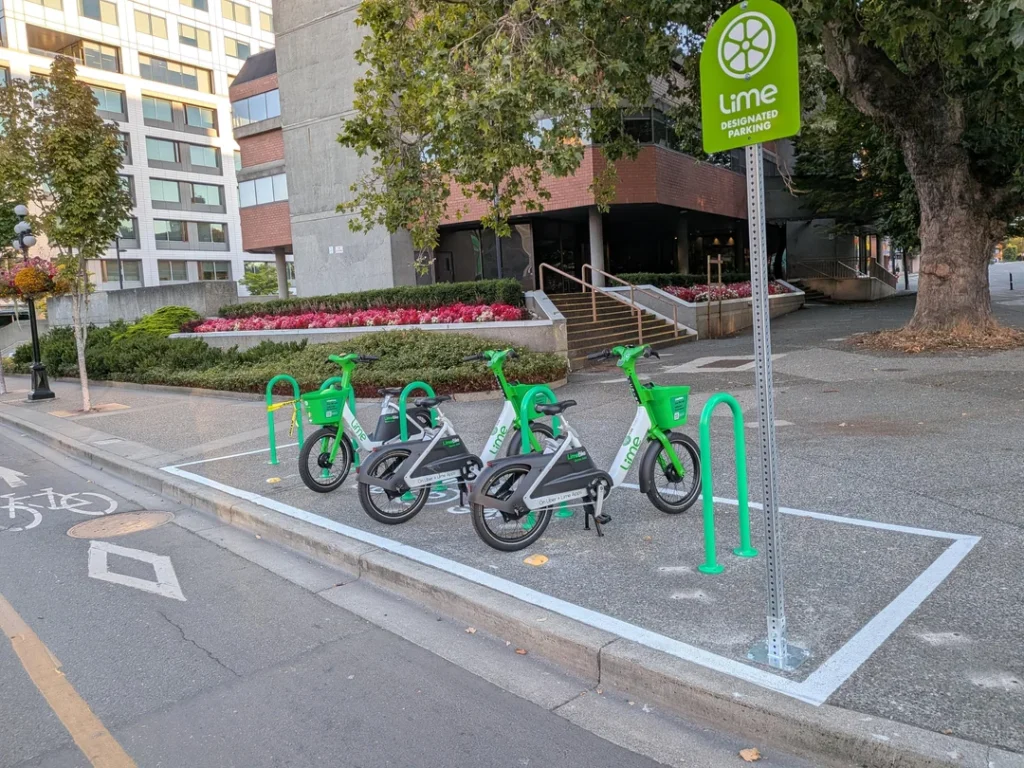
On August 21, 2026, Lime e-bikes officially hit the streets of Victoria. In the eyes of city officials, the launch seems to be a success story. Launching with 110 docking stations across James Bay, Downtown, Vic West, North Park, Hillside-Quadra and Burnside, with citywide coverage planned by year’s end at a density of roughly one parking zone every two to four blocks. This is the city’s second attempt at bike share. The first time was in 2017-2018, which ended with bikes blocking sidewalks, being vandalized, sunken under the Gorge waterway; it was a nightmare in many regards. However, it seems the design lessons have clearly been absorbed. Now, 9 years later, the city has prioritized mandatory parking zones, GPS, speed limiters, and attached helmets: this is a well-specified system.
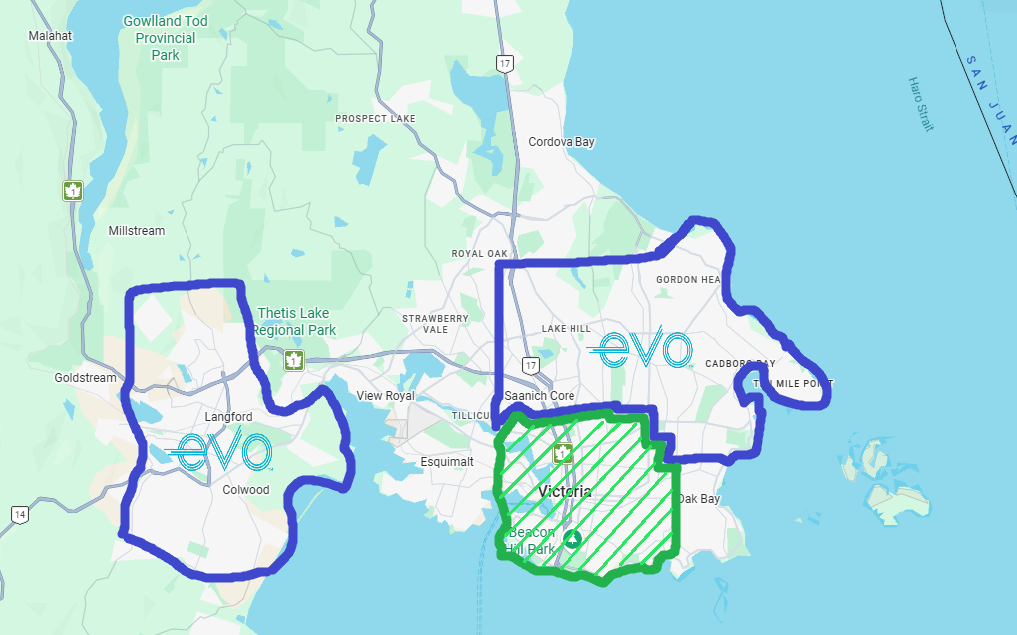
Yet the most consequential decision in the program is the selection of the operator. Victoria selected Lime, a San Francisco-based company backed by Uber. Lime is a well-known bikeshare platform that is used across North America, in Canadian cities such as Calgary, Edmonton, and Vancouver. A consequence of this decision by the Victoria city council is that the system is incompatible with the Evolve network operated by BCAA in Saanich, Langford and Colwood. The result is that the Capital Region, a single integrated region of thirteen municipalities, now runs two geofenced bike share systems that meet at municipal boundaries and go no further. A rider cannot take a bikeshare bike from the University of Victoria to a downtown cafe or office. A tourist staying downtown cannot ride a shared bike out the Galloping Goose, perhaps the region’s most popular biking trail, and dock it in Colwood, even though Evolve stations sit along the trail on the West Shore end.
For municipalities, transit agencies and mobility operators watching from elsewhere, Victoria is a live case study in what happens when procurement is run at the wrong geographic scale. A lesson on what happens when cities don’t prioritize local municipal cooperation
What the city invested in and what it didn’t
Victoria’s model is what city council calls “publicly administered but privately owned and operated”: the City selects a sole operator through competitive procurement, the operator supplies the equipment fleet, the software, and sets pricing. The city then retains regulatory oversight while limiting its financial exposure. Lime pays annual fees to the City of Victoria under a five-year contract with two three-year renewal options. Riders pay $1.15 to unlock and 34 cents per minute, with bundled options ($3.99/30 min, $14.99/120 min) and a $5.99 monthly plan.
On its own terms, this is a defensible, low-risk structure. Typical of urban municipal bodies in Canada, precisely because it minimizes public investment. But “low-risk” is not “no-cost.” The City is funding the construction of the parking zones itself, at an estimated $100,000–$200,000 from its capital transportation budget, and the annual fees Lime pays for the privilege have not been publicly disclosed. A Times Colonist commentary published in launch week made the pointed observation that Victoria taxpayers are building the physical infrastructure on which a private multinational will operate its business. Whether one regards that as a subsidy or a sensible enabling investment.
The deeper issue, however, is not what the City paid. It is what the City specified.
The report that framed the RFP never mentions the region
The April 2025 Committee of the Whole report, “Bringing Bike Share to Victoria”, analyzes ownership models, parking models and device types. It correctly identifies Victoria’s advantages: 40 kilometres of All Ages and Abilities cycling routes which it coins as “AAA” cycling routes, a 13% cycling mode share (among the highest in the country), a strong visitor economy, and, in the City’s own words, its “role as a regional entertainment, shopping and employment centre.”
What the report does not contain, anywhere in its six pages, is a single reference to regional interoperability. Not in the analysis. Not in the enumerated best practices, which emphasize “a consistent user experience” for a sole operator within Victoria. Not in the options presented to Council. Langford’s parallel procurement is mentioned only once, as background, with no discussion of whether Victoria’s choice of operator should be related to it. By the time Victoria’s RFP went out, Evolve was already operating at the University of Victoria’s doorstep in Saanich, where stations are placed explicitly “to support student and faculty mobility”. In the past, BCAA had publicly signalled its intent to bid on Victoria.
Evolve did bid. It lost. Procurement, the City will fairly say, worked exactly as designed. That is precisely the problem: the design never asked the question that mattered most. A competitive process optimizes for the criteria it is given. If regional network compatibility is not weighted, or even a factor at all, the process cannot be expected to deliver it. However, the lack of priority given to regional interoperability is being questioned by regional citizens all over Victoria, Saanich, and Langford.
Why this is important
The critique lands harder because the interoperable alternative isn’t hypothetical; it’s operating across the municipal line. When Evolve expanded into Colwood in April 2026, BCAA’s release led with exactly the value proposition Victoria has now foreclosed: riders can “seamlessly start or end trips in Colwood, Langford, and Saanich, creating a more connected active transportation network that supports cross-community travel without a car.” Three municipalities, one app, one fleet, borderless trips, including stations along the Galloping Goose.
The region has, in effect, built a connected West Shore–Saanich network and an island of Lime in its urban core. The commuter flows that bike share is best suited to serve- UVic to downtown, Esquimalt and Vic West to the West Shore via the Goose and E&N corridors- are exactly the trips that now terminate at a geofence due to a lack of collaborative municipal planning across the different regions.
What the mature systems teach
Canada has 2 flagship bikeshare models that can be used as an example of effective planning and execution. Toronto and Montreal.
Toronto: the parking meters pay for the bikes
In Toronto, the city publicly owns the bike share the same way it owns the bus system, and it pays for it through revenue generated by car parking.
Toronto’s bikes are run by the Toronto Parking Authority, the same city agency that operates paid parking lots and street meters across the city. That agency generates a large portion of revenue from car parking, and a portion of that revenue funds the bike share. So every time someone pays for parking in Toronto, they’re helping pay for the bike network. Cars are literally subsidizing bikes. Advertising deals and pass sales top it up, with occasional grants from higher levels of government for big expansions.
Why should the average rider care about this? When one public agency owns the whole system, the whole city works as one network. There are no company territories, no boundaries where your bike stops working, no second app to download. A rider pays $15 for a day pass and gets unlimited 90-minute rides; a rider can hop off one bike, grab another, all day, anywhere in the city, across more than 1,000 stations in every ward. You can ride from a lakefront patio to a suburb without ever thinking about who operates which zone, because the answer is always the same: the city of Toronto does.
There is, however, a nuance in Toronto’s case, which is that this took patience. The system was operating at a deficit for years, and a city with a private operator would probably never have tolerated that. But because the losses were covered by parking revenue rather than the general tax bill, the city could keep expanding through the weaker revenue years, and it worked. Ridership went from about 2.9 million trips in 2020 to a record 7.8 million in 2025, and the system’s revenue is now growing faster than its costs. Toronto essentially treated bike share as infrastructure that needed time to mature, not a business that needed to profit from day one. That’s the payoff of public ownership: the network was designed with everyday commuters in mind.
Montreal: the city decided bikes are public transit, and paid accordingly
Montreal’s BIXI is the oldest large-scale bike share in North America, and its story of patience and resilience.
BIXI launched in 2009 under a private-style operator that eventually went bankrupt. At that point, Montreal faced the same problem Victoria faced this year: walk away, or take ownership. The city of Montreal bought the whole system, including the bikes and the stations, for $11.9 million and created a non-profit organization, owned by the city, whose only job is to run the bikes. No shareholders, no profit motive. Any money BIXI makes goes back into the system.
Following the acquisition of Bixbi, the city of Montreal began directly funding the system. Direct subsidies of $2.9 million a year through the late 2010s, plus millions more for new bikes, stations and technology. In other words, Montreal funds BIXI the way it funds buses and the métro; as a public service that’s worth paying for because of what it does for the city, not because it turns a profit. Riders cover roughly half the cost through fees; sponsorships and the city cover the rest.
What did those subsidies fund? The scale of Bixi and the regional reach. BIXI now runs roughly 12,600 bikes across 900-plus stations and logged 13 million rides in 2024. And because a city-owned non-profit doesn’t stop at a border to protect a commercial territory, BIXI has expanded beyond Montreal into neighbouring cities like Laval and Longueuil. One app, one network, across municipal lines, which is exactly the trip a Victoria rider can’t make between UVic and downtown. The subsidy is the price of that coherence, and Montreal considers it money well spent: research on BIXI even found that homes near a dense cluster of stations gained about 2.7% in value, meaning some of that public investment quite literally shows up in the neighbourhoods it serves.
Lessons for municipalities considering bikeshare
As with any idea or proposition, the first step is always the most important and always the same, yet it is one of the most common failure points within projects.
There are two legitimate answers, and they lead to very different systems.
The first is revenue and tourism. Your city has a strong visitor market, a private operator wants access to it, and you can charge that operator a fee for the privilege while tourists pay premium per-minute rates to cruise the waterfront. There is nothing wrong with this model. It costs the city little and generates some income. But it is imperative to understand what it is: a concession, like a food truck permit. It will serve visitors well and serve commuters incidentally, because the operator will place bikes where tourists ride, not where residents live.
The second answer is local mobility. The program exists so that people who live and work in the region can get around efficiently, affordably, and without a car: the student getting from campus to downtown, the worker connecting from a bus stop to an office, the resident who wants a healthier, cheaper commute and a better quality of life. If this is your goal, everything about the program changes: pricing needs to be commuter-friendly, coverage needs to follow where people actually travel, and most importantly, the network cannot stop at your municipal boundary, because your residents’ trips don’t. When I was in Toronto, I found many people dressed in their suits and ties, using a bikeshare bike to go to and from their work.
Once you know your answer, the funding question largely answers itself. If the goal is genuine commuter adoption, the Canadian evidence points firmly in one direction: the country’s most successful systems are the ones where the public put real money and ownership behind the network. Montreal treated BIXI as public transit and subsidized it accordingly; Toronto funded its system through parking revenue under public ownership. Both got seamless, region-scale networks with millions of annual rides. A pure concession model has never produced the same result in Canada. It produces what Victoria has today: a network of competing firms within small geographic portions.
When you do go to RFP, two things matter most. First, state the program’s intention in the document itself; evaluators can’t weigh what was never written down, and Victoria’s staff report is proof of what happens when the real objective goes unstated. Second, build in cooperation with your neighbours, whether that’s joint procurement, roaming agreements with adjacent systems, or at minimum a requirement that the winning operator be willing to interoperate across boundaries. Ask your council to see the map of where residents actually travel before they approve the geofence.
Finally, place the stations where life already happens. Bikeshare succeeds as a connector, not a standalone service. It is imperative that cities couple parking zones with the infrastructure that people already use: beside high-frequency bus stops, outside libraries, schools and community centres, at park entrances and trailheads, and throughout downtown office cores. Every station placed next to a transit stop effectively extends that transit line by two kilometres in every direction, at a fraction of the cost of running more buses.
Victoria’s system may still be successful as the fundamentals here are not terrible, and the five-year contract leaves room to negotiate regional alignment, with the CRD as the natural convener. But the lesson of launch week is that connectivity of a large network is the product; be clear on what the intention of the bikeshare is and who the target demographic is, fund it like you mean it, and procure the whole network, not just an individual geographic fraction.
Sources
- CBC News, “Rubber meets the road for Lime e-bike share launch in Victoria” (Aug 20, 2026) – cbc.ca/news/canada/british-columbia/lime-bike-victoria-9.7314520
- CHEK News, “Lime e-bikes launch in Victoria with goal to have parking zones ‘every two to four blocks'” (Aug 21, 2026) – cheknews.ca/lime-e-bikes-launch-in-victoria-with-goal-to-have-parking-zones-every-two-to-four-blocks-1343299
- CHEK News, “Lime selected to launch Victoria’s new e-bike share program this summer” (Jun 25, 2026) – cheknews.ca/lime-selected-to-launch-victorias-new-e-bike-share-program-this-summer-1332693
- City of Victoria, Committee of the Whole report, “Bringing Bike Share to Victoria” (Apr 4, 2025) – https://pub-victoria.escribemeetings.com/filestream.ashx?DocumentId=103321
- Times Colonist, “Victoria seeks companies to launch e-bike-share program” (Jul 2025) – https://www.timescolonist.com/local-news/victoria-seeks-companies-to-launch-ebike-share-program-next-year-10898152
- City of Victoria, “E-Bikes and E-Bike Share” – https://www.victoria.ca/getting-around/walking-riding-rolling/e-bikes-and-e-bike-share
- BCAA / Evolve E-Bike Share announcements and program pages (Saanich, Langford, Colwood, 2025–26) – https://langford.ca/evolve/
- Toronto Parking Authority / Bike Share Toronto system reports and pricing – tpa.ca; bikesharetoronto.com
- BIXI Montréal, corporate history and system statistics – bixi.com